
Home → Manufacturing
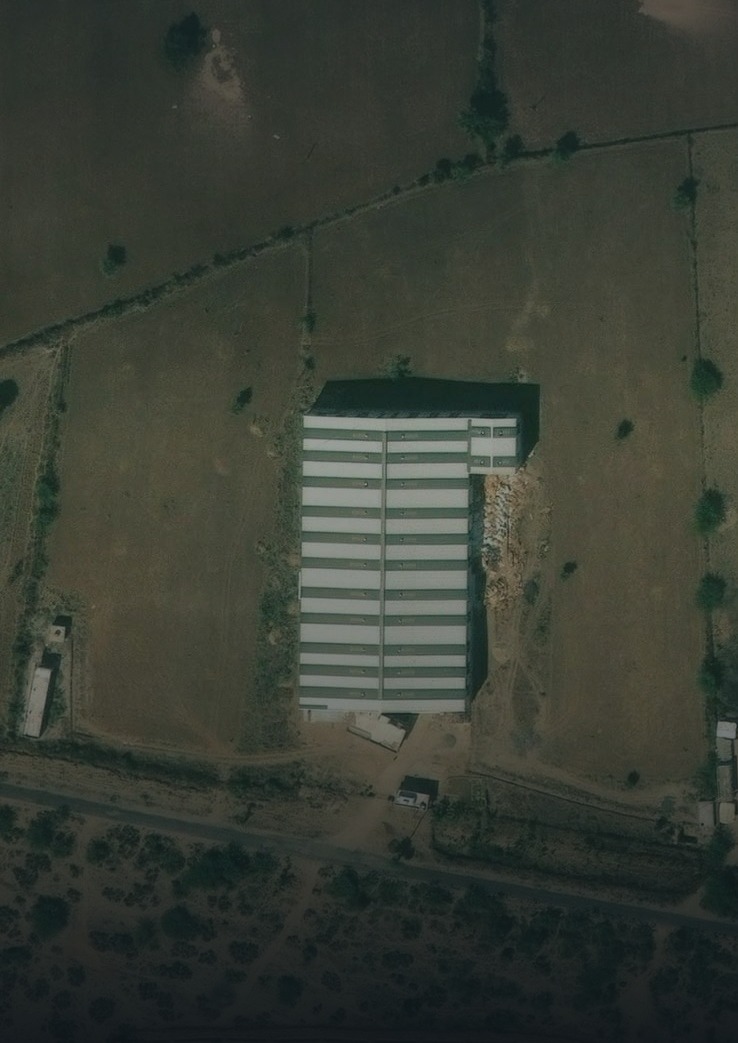
One roof. Every stage.
Foam is poured, rebonded, quilted and finished in the same works. That is less a boast than an explanation: it is why the density holds between orders, and why nobody else has to be chased when something needs fixing.
What is on the floor
Four processes, one building. A mattress does not leave our control between the pour and the packing.
01
Continuous foaming plant
An automated continuous-pour line that yields uniform density and consistent cell structure, block after block. It is the foundation of every foam product we make.
02
Rebonded foam plant
Converts our own foam offcuts into dense, high-load-bearing blocks — zero-waste manufacturing that also produces one of our most structurally robust materials.
03
Fabric quilting unit
Multi-needle computerised quilting for precise, durable stitch patterns across every mattress and pillow cover we produce.
04
Tape-edge finishing line
Clean, reinforced mattress borders for a tailored finish that holds its shape through years of daily use.
The pour, on our own line
A metered stream of polyol, isocyanate and catalyst is laid across the paper-lined trough and begins to rise. Because the line runs continuously rather than box by box, the foam in the tenth metre matches the foam in the first — which is why a repeat order behaves like the last one.
Everything else we make — a mattress core, a hotel pillow, a hospital multi-fold — starts as this pour.
How an order moves through the works
The same flow every order follows, with two inspection gates in it — one before material reaches the floor, one before anything is packed.
-
1
Order received
Sizes, density, variant and quantity confirmed in writing before anything is scheduled.
-
2
Raw material check & purchase order
Stock is checked against the order and the shortfall is bought to specification.
-
3
Material received in store
Every consignment is booked in against its purchase order.
-
4
Incoming inspection (QC)
Materials are checked before they are allowed onto the floor — a bad input is cheapest to catch here.
-
5
Production
Fabrication, upholstery, stitching and assembly run in parallel across the plants.
-
6
Assembly for finished goods
Layers, covers and borders come together into the finished mattress or pillow.
-
7
Final quality check
Dimensions, firmness, stitching and finish are checked against the order before anything is sealed.
-
8
Packing for dispatch
Packed, labelled and loaded, with the grade and batch on the paperwork.
Inside the continuous foaming line
Batch foaming pours one box at a time, and every box is a slightly different foam. A continuous line pours without stopping — the chemistry, the conveyor speed and the laydown are held steady, and consistency becomes the product.
Raw materials in, checked before they are used
Polyol, isocyanate, water, silicone surfactant, catalysts and — where the specification calls for it — flame retardant and pigment. Each consignment is checked against its certificate of analysis before it reaches a day tank, because a drifting polyol shows up later as a drifting density.
Metering: the part that decides the grade
Calibrated pumps dose every stream at a set ratio into the mixing head. Water content sets the gas generated and therefore the density; the isocyanate index sets crosslinking and therefore firmness and durability. Tank temperatures are held steady, because the same formulation poured cold and poured warm are not the same foam.
Continuous laydown
The traversing head lays reacting liquid across the width of a moving, paper-lined trough. Fall-plate geometry keeps the rise flat rather than domed, which protects yield — a crowned block is trim, and trim is money.
Free rise, gel and cure
Blowing and gelling reactions race each other as the bun rises down the tunnel; get the balance wrong and you get splits, voids or a collapsed top. Blocks are then cut off and cured under watch before anything touches a blade — foam cut hot is foam that changes size later.
Cutting to the order
Horizontal cutting takes sheet thickness, vertical cutting takes plan dimensions, and profiled sections are cut to drawing. Clean off-cuts are collected for the rebonding plant rather than dumped.
Quilting and tape-edge
For finished mattresses and pillows, cut foam moves to multi-needle computerised quilting and then to the tape-edge line, where borders are closed and reinforced for a tailored finish that keeps its shape.
The rebonding plant
Rebonding is not a way to hide waste — it is how you make foam far denser than a free-rise pour can reach. Densities at that end of the range cannot come off a foaming line at all; they have to be pressed.
- Sorted trim. Clean off-cuts from our own cutting hall, sorted by type; contaminated scrap is kept out.
- Controlled chip size. Shredded and screened — fine chip for smooth sheet, coarser for high-load blocks.
- Measured binder. Chips are tumbled with polyurethane binder so every surface is wetted without flooding.
- Press and cure. Compression held during cure is what decides where in the range the finished block lands.
- Cut to sheet. Cooled, stabilised, then cut into base layers, cores and cushioning.
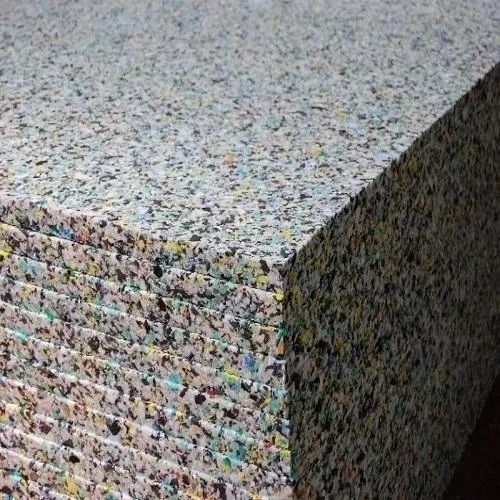
High-density rebonded block, pressed from our own offcuts.
Safety and housekeeping
Flexible PU foam production carries two real risks: isocyanate exposure during pouring, and self-heating in freshly cured blocks. Both are handled with process discipline rather than optimism.
- Ventilated pour area, extraction over the tunnel, and PPE for anyone near the mixing head.
- Isocyanate stored, decanted and spill-kitted to the supplier's handling guidance.
- Cure area kept separate and temperature-watched; blocks are not stacked tight while the exotherm is still running.
- Foam dust and trim cleared continuously — loose trim near a hot block is the classic foam-plant fire.
Plant visits for serious buyers are welcome by appointment. Arrange a visit →
Paperwork
What an assessor or an auditor asks for, in a folder, ready to send.
- Machine schedule — every machine on the floor, by type.
- Process flow diagram — order to dispatch, with the inspection gates marked.
- Inspection procedure — what is checked incoming, and what is checked before packing.
- Safety declaration — handling, storage and cure-area practice.
- Supplier list — where the polyol, isocyanate and fabric come from.
- Statutory record — GSTIN 08AAFCP8356E1Z7, CIN U36104RJ2011PTC033984, incorporated 28 January 2011, registered trade mark.
Any of these go out on request when you are assessing us as a vendor.
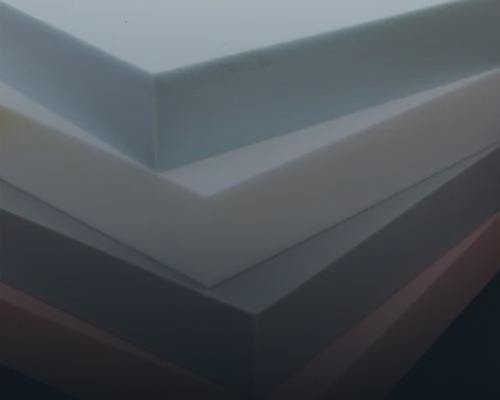
Cut sheet, checked against the ordered density before it leaves.
Put this line behind your product
Foam, mattress or pillow — specify it and we will manufacture it, from raw polyurethane to the final stitch.